
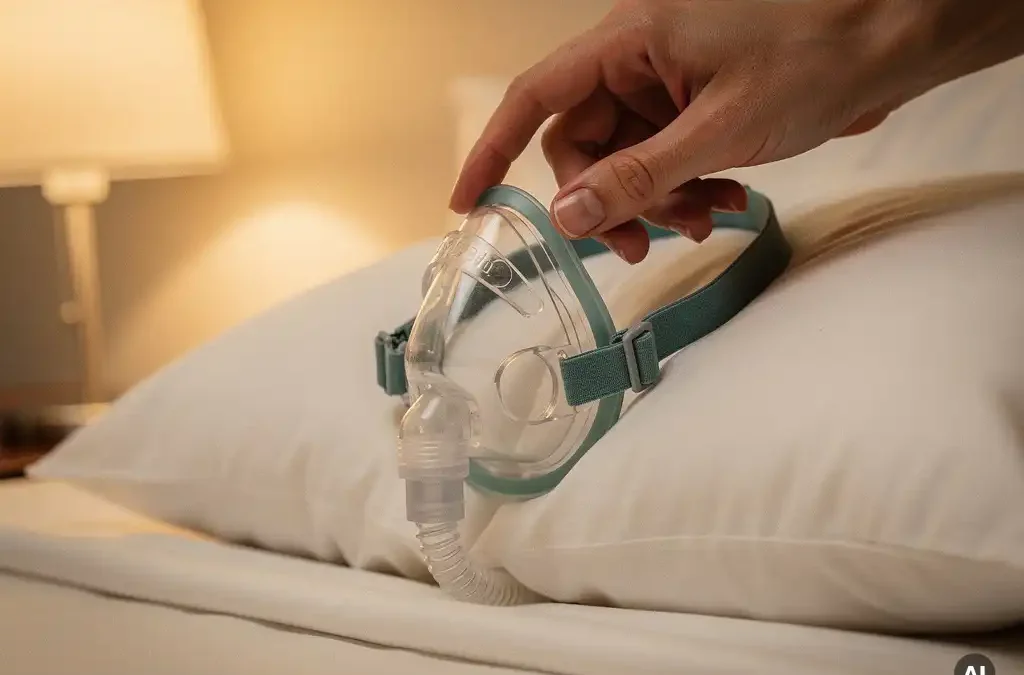
Your CPAP mask should be snug enough to create a seal without pressing uncomfortably into your skin. A well-fitted mask holds its position during sleep and prevents air from escaping around the edges, but it should never leave deep marks on your face or cause pain. Getting this balance right is one of the most important factors in making CPAP therapy work for you. Below, we answer the most common questions about CPAP mask fit so you can sleep comfortably and get the full benefit of your therapy.
What happens if your CPAP mask is too loose or too tight?
A CPAP mask that is too loose will leak air around the seal, reducing the pressure delivered to your airway and making your therapy less effective. A mask that is too tight creates unnecessary pressure on your skin, causing discomfort, red marks, sores, and sometimes even worsening leaks by distorting the cushion’s shape. Both extremes interfere with sleep apnea treatment.
When a mask leaks because it is too loose, your CPAP machine may compensate by increasing pressure, which can cause discomfort and dry mouth. Over time, poor therapy results from a leaking mask can leave you waking up just as tired as before treatment. On the other hand, over-tightening compresses the cushion so much that it buckles and gaps, creating new leak points rather than eliminating them. Many people make the mistake of tightening further when leaks appear, which actually makes the problem worse.
How do you know when your CPAP mask fits correctly?
A correctly fitted CPAP mask sits comfortably against your face, maintains a consistent seal when pressure is applied, and does not shift during normal sleep movement. You should be able to slide two fingers under the headgear straps without forcing them. After a full night’s use, the mask should leave only light, temporary impressions on your skin rather than deep red marks or sores.
A practical way to check fit is to put on your mask, connect it to your CPAP machine, and turn the therapy on while sitting upright. Then lie down in your usual sleep position and check whether the seal holds. Minor adjustments at this stage are normal. If you feel air blowing into your eyes or hear a significant hissing sound from around the cushion, the seal is not adequate. A good fit feels secure but not restrictive, and you should be able to breathe naturally through your nose or mouth depending on your mask type.
Why does my CPAP mask keep leaking even when tightened?
Persistent CPAP mask leaking after tightening is almost always caused by a worn or damaged cushion, an incorrect mask size, or the wrong mask style for your face shape. Over-tightening distorts the cushion and creates gaps rather than closing them. Leaks that continue despite adjustments are a signal that something other than strap tension needs to change.
Cushion material degrades with regular use, losing its flexibility and ability to conform to your facial contours. Oils from your skin accelerate this process, which is why cleaning your mask daily with mild soap and water is essential. If your cushion is more than a few months old and leaks are increasing, replacement is the most likely solution. It is also worth considering whether your mask size is still correct. Weight changes, even modest ones, can alter the fit of a mask that previously worked well. Finally, if you have tried multiple cushion sizes and still experience leaks, the mask style itself may not suit your facial structure.
Should you tighten your CPAP mask while lying down or sitting up?
You should make your initial CPAP mask adjustments while sitting up, then fine-tune the fit while lying down in your normal sleep position. Facial muscles relax differently when you lie down, and gravity shifts the mask slightly, so a fit that feels perfect sitting up may leak when you are horizontal. Always confirm the final adjustment in the position you actually sleep in.
Start by putting on the mask while seated and adjusting the headgear until it feels snug without being tight. Then lie down, turn on your CPAP machine, and pay attention to where any air escapes. Small strap adjustments made in this position will be far more accurate than those made sitting upright. If you sleep on your side, test the fit in that position specifically, as side sleeping places different pressure on the mask than sleeping on your back.
What’s the difference between mask types and how does it affect fit?
The three main CPAP mask types are full face masks, nasal masks, and nasal pillow masks, and each fits differently based on the area of the face it covers. Full face masks seal around both the nose and mouth, nasal masks cover only the nose, and nasal pillow masks insert lightly into the nostrils. Your ideal fit depends on your breathing pattern, sleep position, and facial anatomy.
Full face masks
Full face masks cover a larger surface area and require careful adjustment across multiple contact points, including the forehead, cheeks, and chin. They are a good choice for mouth breathers but can feel bulky and are more prone to leaking if not fitted precisely. Side sleepers often find full face masks more difficult to keep sealed through the night.
Nasal and nasal pillow masks
Nasal masks and nasal pillow masks are lighter and easier to fit, making them popular with side sleepers and those who feel claustrophobic in a full face design. Nasal pillow masks in particular have a minimal footprint and rely on a gentle seal at the nostrils rather than across the face. However, neither option works well if you breathe through your mouth during sleep, as air will escape through your open mouth and reduce therapy effectiveness. A chin strap can sometimes address this, but it is worth discussing with your care team. If you are unsure which mask style suits you best, our team can help you find the right fit through our CPAP mask fitting tool.
When should you replace your CPAP mask cushion or headgear?
CPAP mask cushions should generally be replaced every one to three months, and headgear should be replaced every six to twelve months. These are general guidelines rather than strict rules. The real indicator is performance. If your cushion has lost its softness, developed cracks, or no longer holds a seal despite correct positioning, it is time to replace it regardless of how long you have had it.
Daily cleaning extends the life of your mask components significantly, but it does not stop the natural breakdown of silicone and foam over time. Skin oils, facial creams, and sunscreen all degrade cushion material faster, so avoid applying these products before putting on your mask. Headgear stretches with repeated use and washing, and once it no longer holds tension evenly, it becomes difficult to maintain a consistent seal. Replacing worn components promptly is one of the simplest and most cost-effective steps you can take to protect the quality of your CPAP therapy and ensure you are getting the treatment pressure your sleep specialist prescribed.
Frequently Asked Questions
Can I adjust my CPAP mask fit myself, or do I need to see a specialist?
Most basic fit adjustments — such as tightening or loosening headgear straps, repositioning the cushion, or trying a different cushion size — can be done at home by following your mask’s user guide. However, if you have tried multiple adjustments and still experience persistent leaks, discomfort, or poor therapy results, it is worth consulting a CPAP specialist or using a mask fitting tool. A professional can assess your facial anatomy, review your machine’s data, and recommend a mask style or size that is better suited to you.
How do I know if my CPAP mask is the right size for my face?
Most CPAP mask manufacturers provide sizing guides that use measurements of specific facial features — such as the distance between the bridge of your nose and your upper lip for nasal masks, or the width of your nostrils for nasal pillow masks. If your cushion consistently gaps at one side, leaves uneven marks, or requires extreme strap tension to hold a seal, it is a strong sign you are using the wrong size. Many suppliers offer fit kits that include multiple cushion sizes so you can compare before committing to one.
What should I do if my CPAP mask causes skin irritation or pressure sores?
First, check whether the mask is over-tightened, as this is the most common cause of skin irritation and sores. Loosen the headgear slightly and confirm the cushion is clean and undamaged. If irritation persists, CPAP mask liners — thin fabric barriers that sit between the cushion and your skin — can reduce friction and pressure significantly. For sores that do not heal or worsen, speak with your healthcare provider, as prolonged skin breakdown can become a more serious issue.
Why does my CPAP mask fit well when I fall asleep but leak by morning?
This is a very common issue and is usually caused by natural movement during sleep — rolling over, shifting positions, or unconsciously pulling at the mask — which gradually displaces the headgear. A worn or degraded cushion that loses its conforming ability as it warms up overnight can also be the culprit. If you are a restless sleeper, consider a mask style with a more secure, lower-profile fit such as a nasal pillow mask, and check whether your headgear has stretched to the point where it no longer holds tension consistently.
Does losing or gaining weight affect my CPAP mask fit?
Yes, even modest changes in body weight can alter the contours of your face enough to affect how your CPAP mask seals. Weight loss in particular can cause a previously well-fitted cushion to gap or sit unevenly, while weight gain may make a mask feel tighter or cause new pressure points. If you have experienced noticeable weight changes and your therapy results have declined, trying a different cushion size should be one of your first troubleshooting steps.
Is it normal to need a break-in period before my CPAP mask feels comfortable?
Yes, it is completely normal to feel some initial discomfort or unfamiliarity with a new CPAP mask, especially if you are new to therapy or switching mask styles. Many clinicians recommend a gradual desensitization approach — wearing the mask while awake and relaxed for short periods before using it during sleep — to help you adjust to the sensation. Most people find that discomfort diminishes significantly within one to two weeks, provided the mask is correctly fitted and the headgear is not over-tightened.
Can using a humidifier with my CPAP machine affect how my mask fits or seals?
A humidifier does not directly affect mask fit, but it can indirectly influence your experience. Adequate humidification reduces dryness and nasal congestion, which can make it easier to breathe through a nasal or nasal pillow mask without resorting to mouth breathing — a common cause of therapy-reducing air leaks. Conversely, if condensation builds up inside the tubing and reaches the mask (a phenomenon known as rainout), the excess moisture can temporarily break the cushion’s seal. Using a heated tube or adjusting your humidifier settings can resolve this.